


Ronak Kothari is the founder of RONKOT, a full-service digital marketing agency.
Why Local SEO is Critical for Small Business Success
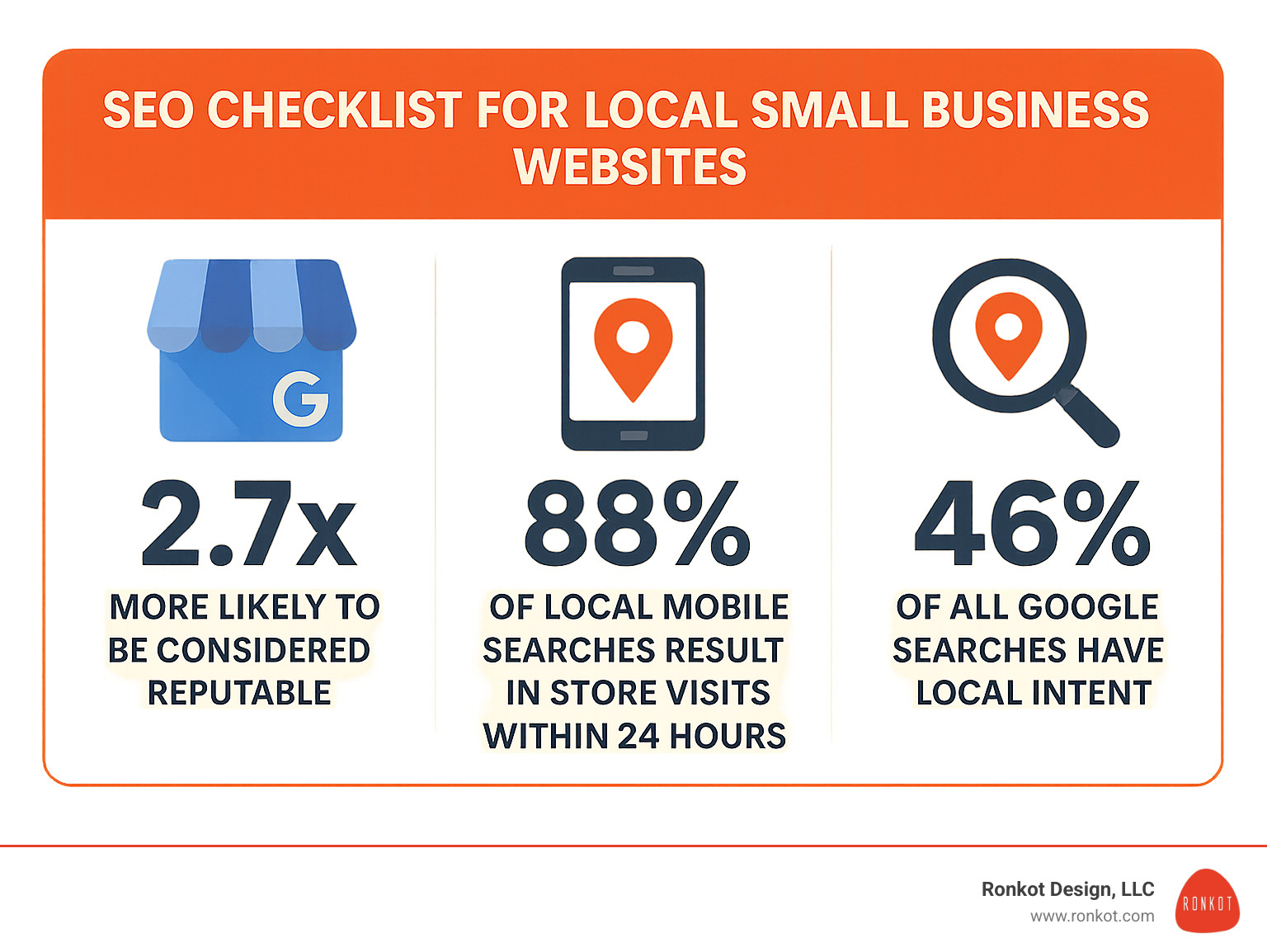
An seo checklist for local small business websites is essential because 46% of all Google searches have local intent, yet most small businesses miss critical optimization opportunities that could drive more customers through their doors.
Essential Local SEO Checklist for Small Business Websites:
- Claim and optimize Google Business Profile – Complete all fields, add photos, verify location
- Ensure NAP consistency – Name, Address, Phone must match across all directories
- Build local citations – Submit to top directories and industry-specific sites
- Optimize on-page elements – Title tags, meta descriptions, location-specific keywords
- Create location/service pages – Unique content for each city and service offered
- Implement local schema markup – Help search engines understand your business data
- Generate and manage reviews – Focus on Google reviews and professional responses
- Build local backlinks – Partner with local organizations and businesses
- Optimize for mobile – Ensure fast loading and click-to-call functionality
- Track local SEO performance – Monitor rankings, traffic, and conversion metrics
When customers search for services “near me” or in their city, they’re ready to buy. Nearly 60% of Google searches now end without a click, making it crucial to appear in the local pack and knowledge panel where customers can contact you directly.
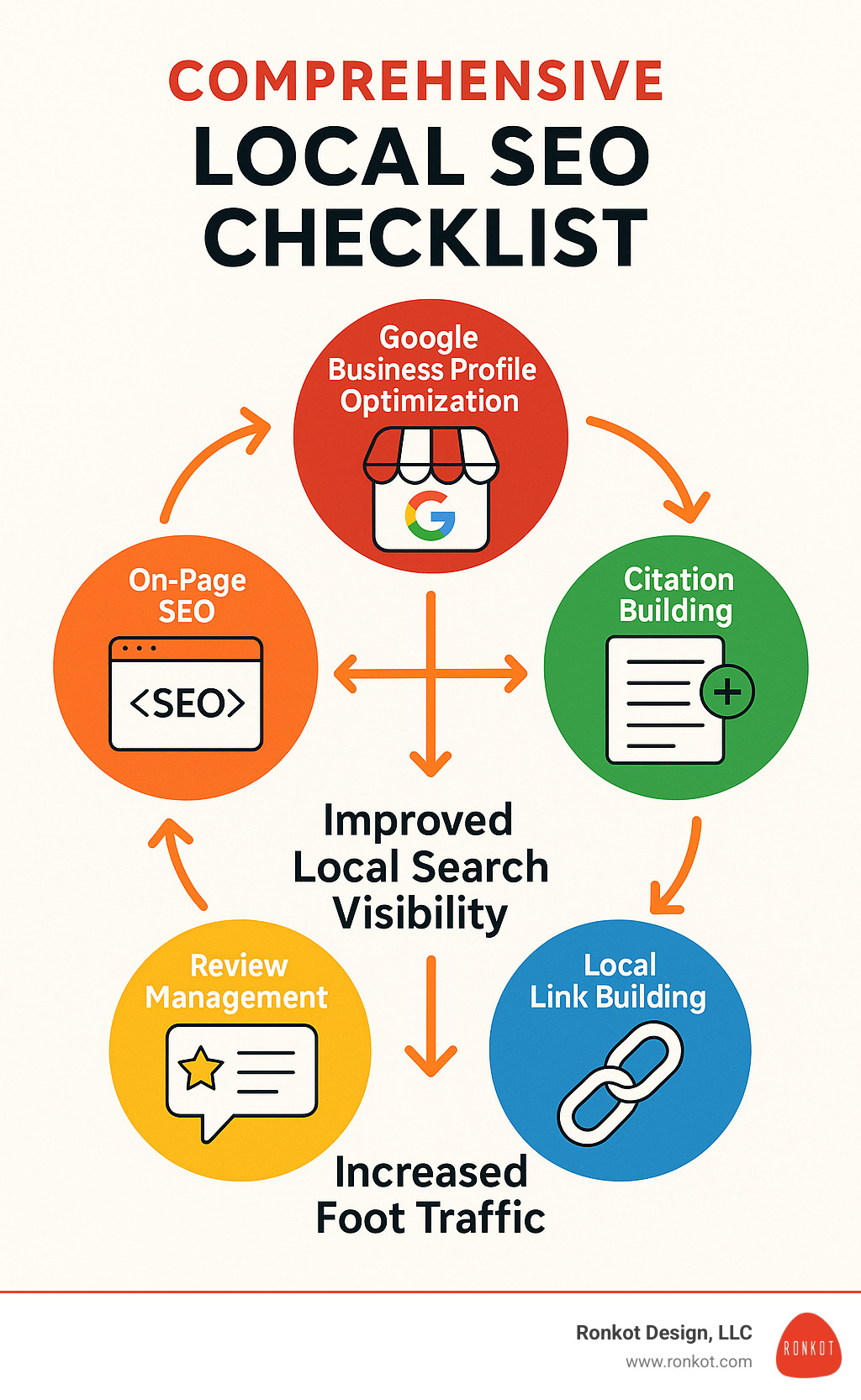
The challenge is that local SEO involves both traditional SEO fundamentals and location-specific tactics that many business owners overlook. From Google Business Profile optimization to citation building and review management, each element works together to signal relevance and trustworthiness to search engines.
I’m Ronak Kothari, CEO and Creative Director of Ronkot Design. After a decade managing marketing operations for a hotel development company, I’ve helped hundreds of local businesses implement comprehensive seo checklist for local small business websites strategies that drive measurable results. Let me walk you through the exact checklist we use to help our clients dominate local search results.
Common seo checklist for local small business websites vocab:
– google maps optimization
– local business review sites
– optimize for voice search
SEO Checklist for Local Small Business Websites: Step-by-Step Blueprint
Think of local SEO like building a house – you need a solid foundation, strong walls, and a roof that protects everything underneath. That’s exactly how we approach our seo checklist for local small business websites at Ronkot Design.
The beautiful thing about local SEO is that it breaks down into three manageable categories. On-page SEO focuses on what’s directly on your website – your title tags with local keywords, meta descriptions, H-tags with geo-modifiers, NAP consistency, service and location pages, plus internal linking. Off-page SEO covers everything that happens outside your website but impacts your rankings – Google Business Profile optimization, citation building, review generation, local backlinks, social media profiles, and directory submissions. Finally, technical SEO ensures search engines can properly crawl and understand your site through mobile-friendliness, page speed optimization, schema markup, HTTPS security, XML sitemaps, and Core Web Vitals.
Here’s what makes local SEO so powerful: businesses with complete Google Business Profiles are 2.7 times more likely to be considered reputable by consumers. This gives small businesses a real competitive advantage when they follow our systematic approach.
Claim & Optimize Google Business Profile
Your Google Business Profile is like your digital storefront – it’s often the first thing potential customers see when they search for your services. I’ve watched businesses increase their local visibility by 300% simply by completing their profile properly.
The verification process is your starting point. Google provides instructions with a helpful video here that walks you through claiming your listing step by step.
Once verified, choosing precise categories becomes crucial. Select your primary category first – this tells Google what your business actually does. Then add up to 9 additional relevant categories that describe your services. Don’t get creative here; stick to Google’s suggested categories.
Completing every field might seem tedious, but it’s worth the effort. Fill in your business hours, phone number, website, description, and attributes. Think of attributes as little flags that tell customers what makes you special – whether you offer free Wi-Fi, accept credit cards, or provide wheelchair accessibility.
High-quality photos work like magic for local SEO. Upload exterior shots so customers can find your building, interior photos that showcase your space, team pictures that build trust, and product images that demonstrate your work. We recommend taking advantage of Google’s free virtual tour builder to let customers “step inside” virtually.
Posting regularly keeps your profile active and engaging. Share updates, offers, events, and news at least weekly. The Q&A section often gets overlooked, but proactively answering common questions about your business helps both customers and search engines understand what you offer.
For detailed guidance, check out our More info about Google My Business setup resource.
Nail NAP Consistency & Build Citations
NAP consistency – that’s Name, Address, Phone Number – acts like your business’s fingerprint across the internet. Even small discrepancies can confuse search engines and hurt your rankings.
Auditing existing citations should be your first step. Find where your business is already listed online, then clean up inconsistencies to ensure identical NAP across all platforms. This detective work pays off big time.
Submitting to major directories comes next – Google, Bing, Yelp, Facebook, and Apple Maps are non-negotiables. Then target industry-specific directories by finding niche sites relevant to your business. A plumber should be on HomeAdvisor, while a restaurant needs OpenTable.
Here’s a pro tip: monitor competitor citations to identify gap opportunities where competitors are listed but you’re not. It’s like finding hidden treasure.
The key data aggregators like Infogroup and Localeze distribute your information to hundreds of smaller directories. Getting listed on these major platforms creates a ripple effect that improves your overall citation profile. Think of Yext as an alternative solution, though there are other options that might fit your budget better.
Our Simple Local SEO Checklist provides a comprehensive list of the top directories for citation building.
On-Page & Technical Essentials
Technical SEO ensures search engines can crawl, understand, and rank your website effectively. With 88% of consumers who do a local search on their smartphone visiting or calling a store within a day, mobile optimization isn’t optional anymore.
Title tags need your primary keyword and location, staying under 60 characters so they don’t get cut off in search results. Meta descriptions should include compelling copy with local keywords under 160 characters – think of them as your elevator pitch to searchers.
H1 tags get one per page with your primary keyword and location, while H2 and H3 tags organize your content with secondary keywords. Internal linking connects related service and location pages, helping both users and search engines steer your site. Click-to-call buttons are essential – make those phone numbers clickable on mobile devices.
HTTPS security has become an essential ranking factor and trust signal. Mobile-friendly design means responsive layouts that work beautifully on all devices. Page speed under 3 seconds keeps visitors happy – use Google PageSpeed Insights to identify what’s slowing you down. Your XML sitemap helps search engines find all your pages efficiently.
For comprehensive guidance, visit our Ways to Improve Website’s SEO guide.
Create Location & Service Pages
Unique location and service pages help you rank for specific geo-targeted searches. I’ve seen businesses double their organic traffic by creating well-optimized location pages for each city they serve.
Unique content is non-negotiable – never duplicate content across location pages. Search engines penalize this heavily. Embedded Google Maps should show your exact location with driving directions, making it easy for customers to find you.
Local testimonials from customers in each area build credibility, while local landmarks help search engines understand your geographic relevance. Reference nearby businesses and attractions that locals recognize.
Service-specific information should be custom to local needs and preferences. A landscaping company might emphasize snow removal in northern cities but focus on drought-resistant plants in desert areas. FAQ sections that answer location-specific questions show search engines you understand local customer concerns.
LocalBusiness schema markup helps search engines understand your business data through structured code. Key properties include areaServed, geoCoordinates, hasMap, telephone, and address. See the full list here for complete schema documentation.
Understanding local keyword research is crucial for creating effective location pages. Our The Importance of Keyword Research guide explains how to find the right geo-modified keywords for your business.
Earn Reviews & Manage Reputation
Online reviews are like digital word-of-mouth recommendations. Businesses with more reviews and higher ratings are more likely to appear in the Google local pack.
Asking at the right time makes all the difference – request reviews immediately after positive interactions when customers are happiest. Making it easy means using Google’s Marketing Kit to create professional review request materials.
Responding to all reviews shows you care about customer feedback. Thank positive reviewers genuinely and address concerns professionally. Monitoring review velocity helps maintain a steady stream rather than sudden influxes that might look suspicious to Google.
Using reviews in marketing amplifies their impact – feature positive reviews on your website and social media to build social proof.
Professional response guidelines keep your reputation intact: respond within 24-48 hours, thank customers for positive feedback, address negative reviews with empathy and solutions, keep responses professional and brief, and offer to resolve issues offline when appropriate.
Avoid common pitfalls by reading our Local SEO Mistakes and How to Avoid Them guide.

Advanced & Often-Overlooked Local SEO Tactics
Once you’ve mastered the basics, it’s time to explore the advanced strategies that separate good local SEO from great local SEO. These tactics focus on the subtle signals that search engines use to determine which businesses deserve the top spots in local search results.
Most small businesses miss these opportunities because they seem technical or time-consuming. But here’s the thing – these advanced tactics for your seo checklist for local small business websites often provide the biggest competitive advantages because so few businesses implement them properly.
The secret lies in understanding how search engines interpret user behavior, voice search patterns, and relationship signals between local businesses. When you optimize for these factors, you’re not just improving your rankings – you’re creating a better experience for potential customers.
Schema & Structured Data Deep-Dive
Think of schema markup as a translator between your website and search engines. While basic LocalBusiness schema is essential, advanced structured data helps you appear in rich snippets, answer boxes, and other premium search features.
Advanced schema implementation goes far beyond the basics. The areaServed property tells search engines exactly which cities and regions you serve, while geoCoordinates provide precise latitude and longitude data. The hasMap property connects your website directly to your Google Maps listing, and Review schema helps individual customer testimonials appear in search results.
FAQ schema is particularly powerful because it helps your content appear in featured snippets. When someone searches “What’s the best HVAC company in Dallas?” your FAQ content could appear at the top of search results.
Here’s how we implement comprehensive schema markup for our clients:
json

{

"@context": "https://schema.org",

"@type": "LocalBusiness",

"name": "Your Business Name",

"address": {

"@type": "PostalAddress",

"streetAddress": "123 Main Street",

"addressLocality": "Dallas",

"addressRegion": "TX",

"postalCode": "75201"

},

"areaServed": ["Dallas", "Colleyville", "Texas"],

"geoCoordinates": {

"@type": "GeoCoordinates",

"latitude": "32.7767",

"longitude": "-96.7970"

}

}
The complete Local business schema documentation provides all available properties, but focus on the ones that directly impact your local search visibility.
Voice Search & Conversational Content for seo checklist for local small business websites
Voice search is changing how people find local businesses. With 149.8 million Americans using voice assistants, optimizing for conversational queries is no longer optional – it’s essential.
Voice searches sound completely different from typed searches. Instead of typing “Dallas plumber,” people ask their phones “Who’s the best plumber near me?” or “What plumber is open right now?” This shift toward natural language requires a different content approach.
The key is creating content that answers questions the way people actually ask them. Write FAQ sections using conversational language. Instead of targeting “emergency plumbing services,” optimize for “What do I do if my pipes burst at night?” This natural language approach helps you capture voice search traffic.
Featured snippets are crucial for voice search success because voice assistants often read these answers aloud. Structure your content to answer questions directly and concisely. Keep answers between 40-60 words for optimal voice search performance.
Mobile optimization becomes even more critical with voice search since most voice queries happen on mobile devices. Fast-loading pages with clear, scannable content perform better in voice search results.
Local Link Building & Partnerships
Local backlinks work differently from traditional link building. Search engines view links from local organizations, businesses, and community websites as strong relevance signals for local search.
The most effective local links come from genuine community relationships. Chamber of Commerce memberships provide directory listings and networking opportunities that naturally lead to more links. Local blogger partnerships create content collaboration opportunities that benefit both parties.
Customer testimonials create a win-win link building opportunity. Offer to provide testimonials for your vendors, suppliers, or business partners in exchange for a link back to your website. This strategy works because testimonials provide social proof for them while building local authority for you.
Event sponsorships and scholarship programs generate high-quality local coverage and backlinks. Even small sponsorships of community events often result in website mentions and links from event organizers.
Press releases for newsworthy business developments can earn coverage from local media outlets. New location openings, significant hires, community involvement, or industry awards all provide opportunities for local press coverage.
The goal isn’t just collecting links – it’s building genuine relationships within your community. These connections often lead to referrals, partnerships, and natural link opportunities that continue providing value long after the initial outreach.
Our Free Local SEO Tools for Small Business guide includes specific tools for finding local link opportunities in your area.
Tracking, Measuring, and Staying Up-to-Date
Measuring local SEO success requires tracking both traditional SEO metrics and location-specific performance indicators. We use a combination of tools to provide comprehensive reporting for our clients.
Essential Tools & KPIs for SEO Checklist for Local Small Business Websites
Core Local SEO Metrics:
- Local pack visibility – Track rankings in the Google local 3-pack
- Organic traffic for geo-targeted keywords – Monitor traffic from location-specific searches
- Click-to-call rates – Measure phone calls generated from search
- Direction requests – Track Google Maps direction clicks
- Review velocity and ratings – Monitor review generation and average rating
- Website conversions – Track form submissions, calls, and purchases
Essential Tools Setup:
- Google Analytics 4 – Track website traffic and conversions
- Google Search Console – Monitor search performance and technical issues
- Google Business Profile Insights – Track profile views, calls, and direction requests
- Call tracking software – Measure phone calls from different marketing channels
- Local rank tracking tools – Monitor position in local pack and organic results
For comprehensive tool recommendations, check our Top SEO Tools to Monitor & Evaluate Your Website guide.
Audit & Iterate Schedule
Local SEO requires ongoing maintenance and optimization. We recommend a structured approach to monitoring and improving your local search presence.
Monthly Tasks:
– Review Google Business Profile insights
– Monitor and respond to new reviews
– Check NAP consistency across major directories
– Update business hours and information
– Publish fresh content and social media posts
Quarterly Tasks:
– Conduct comprehensive local SEO audit
– Review and update location/service page content
– Audit citation profile for new opportunities
– Analyze competitor local SEO strategies
– Update schema markup and technical elements
Annual Tasks:
– Complete website technical audit
– Review and refresh all location page content
– Evaluate and update local SEO strategy
– Assess tool stack and reporting processes
Our Local SEO Audit service provides comprehensive quarterly reviews to keep your local SEO strategy optimized.
Frequently Asked Questions about Local SEO
When helping small businesses implement their seo checklist for local small business websites, we get asked the same questions repeatedly. Let me address the three most common concerns that keep business owners up at night.
What are the top 3 local SEO ranking factors?
Google uses three primary signals to determine which businesses appear in local search results. Understanding these factors helps you focus your efforts where they’ll make the biggest impact.
Proximity is the distance between your business and the person searching. If someone searches for “coffee shop” from downtown Dallas, Google will prioritize nearby cafes over those across town. While you can’t move your physical location, you can optimize for this by clearly defining your service areas and using location-specific content.
Relevance measures how well your business matches what someone is searching for. This is where your Google Business Profile categories, website content, and keyword optimization really matter. When someone searches for “emergency plumber,” Google wants to show plumbers, not general contractors who occasionally fix pipes.
Prominence reflects your business’s reputation and authority online. This includes your review ratings, the number of citations across the web, and quality backlinks to your website. Think of prominence as Google’s way of measuring how well-known and trusted your business is in your community.
The good news? While proximity is fixed, you have complete control over relevance and prominence through consistent optimization efforts.
How do I handle multi-location SEO without duplicate content?
Multi-location businesses face a unique challenge with their seo checklist for local small business websites. Google penalizes duplicate content, but you need pages for each location. The solution is creating genuinely unique content for every location.
Create distinct pages for each location by including different local landmarks, neighborhood-specific services, and unique customer testimonials. Instead of copying the same service description, mention how your Dallas location serves the Arts District differently than your Plano location serves Legacy West.
Set up separate Google Business Profiles for each physical location. Each profile should have its own unique photos, posts, and customer interactions. Never try to use one profile for multiple locations – Google will penalize you for this.
Implement proper canonical structure to tell search engines which page is the “master” version when you have similar content. This prevents Google from getting confused about which page to rank for specific searches.
The key is making each location page feel like it was written specifically for that community, not just a template with the city name swapped out.
How often should I update my local SEO checklist?
Local SEO isn’t a “set it and forget it” strategy. Search algorithms change, competitors improve their efforts, and your business evolves. We recommend a two-tier approach that balances thoroughness with efficiency.
Monthly micro-checks keep your local presence fresh and responsive. This includes reviewing your Google Business Profile insights to see how customers find you, responding to new reviews professionally and promptly, and updating any changed business information like holiday hours or new services.
Quarterly full audits ensure nothing falls through the cracks. Every three months, conduct a comprehensive review of your citation profile, analyze competitor strategies, refresh location page content, and check that all technical elements are working properly.
Google’s algorithm updates can impact local search results significantly. Core updates typically happen several times per year, and staying on top of these changes helps you maintain your rankings. The businesses that consistently monitor and adjust their local SEO strategy are the ones that dominate local search results long-term.
Local SEO is a marathon, not a sprint. Small, consistent improvements compound over time to create significant competitive advantages in your market.
Conclusion
Implementing a comprehensive seo checklist for local small business websites is essential for competing in today’s digital marketplace. From Google Business Profile optimization to advanced schema markup and local link building, each element works together to improve your local search visibility.
Here’s the reality: 75%-90% of people only look at the first page of search results. That means if your business isn’t showing up when locals search for your services, you’re essentially invisible to potential customers who are ready to buy.
The good news? Local SEO levels the playing field. Unlike national SEO where you’re competing against massive corporations, local search gives small businesses a real shot at dominating their market. When someone searches for “plumber near me” or “best restaurant in Dallas,” they’re not looking for the biggest company—they’re looking for the most relevant, trustworthy option nearby.
At Ronkot Design, LLC, we help businesses throughout Texas—from our home base in Colleyville to Dallas and beyond—implement every item on this checklist for sustainable local growth. Our data-driven, customer-centric approach ensures that your local SEO strategy aligns with your business goals and delivers measurable results.
After working with hundreds of local businesses, I’ve seen how the right seo checklist for local small business websites can transform a struggling business into a local market leader. The secret isn’t just knowing what to do—it’s about consistent execution and ongoing optimization.
Start with the foundational elements like Google Business Profile and NAP consistency, then gradually implement the advanced tactics as your local presence grows stronger. Don’t try to tackle everything at once. Pick three items from this checklist, master them, then move on to the next three.
Ready to dominate local search results? Our team specializes in creating customized local SEO strategies that drive real business growth. We don’t just check boxes—we create strategy alignment that makes sense for your specific business and market.
For more information about developing a comprehensive approach custom to your business, visit our More info about local SEO strategy page.
Don’t let your competitors capture the customers who are actively searching for your services in your area. Start implementing this seo checklist for local small business websites today and watch your local visibility soar. Your future customers are searching right now—make sure they find you first.
Ronak Kothari is the founder of RONKOT, a full-service digital marketing agency.