


Ronak Kothari is the founder of RONKOT, a full-service digital marketing agency.
Why Local Visibility is Critical for Your Business Growth
Local SEO for small business growth is the process of optimizing your online presence to attract more customers from relevant local searches. Small businesses can achieve significant growth through local SEO by appearing in Google’s Map Pack, improving organic rankings, and converting nearby searchers into customers.
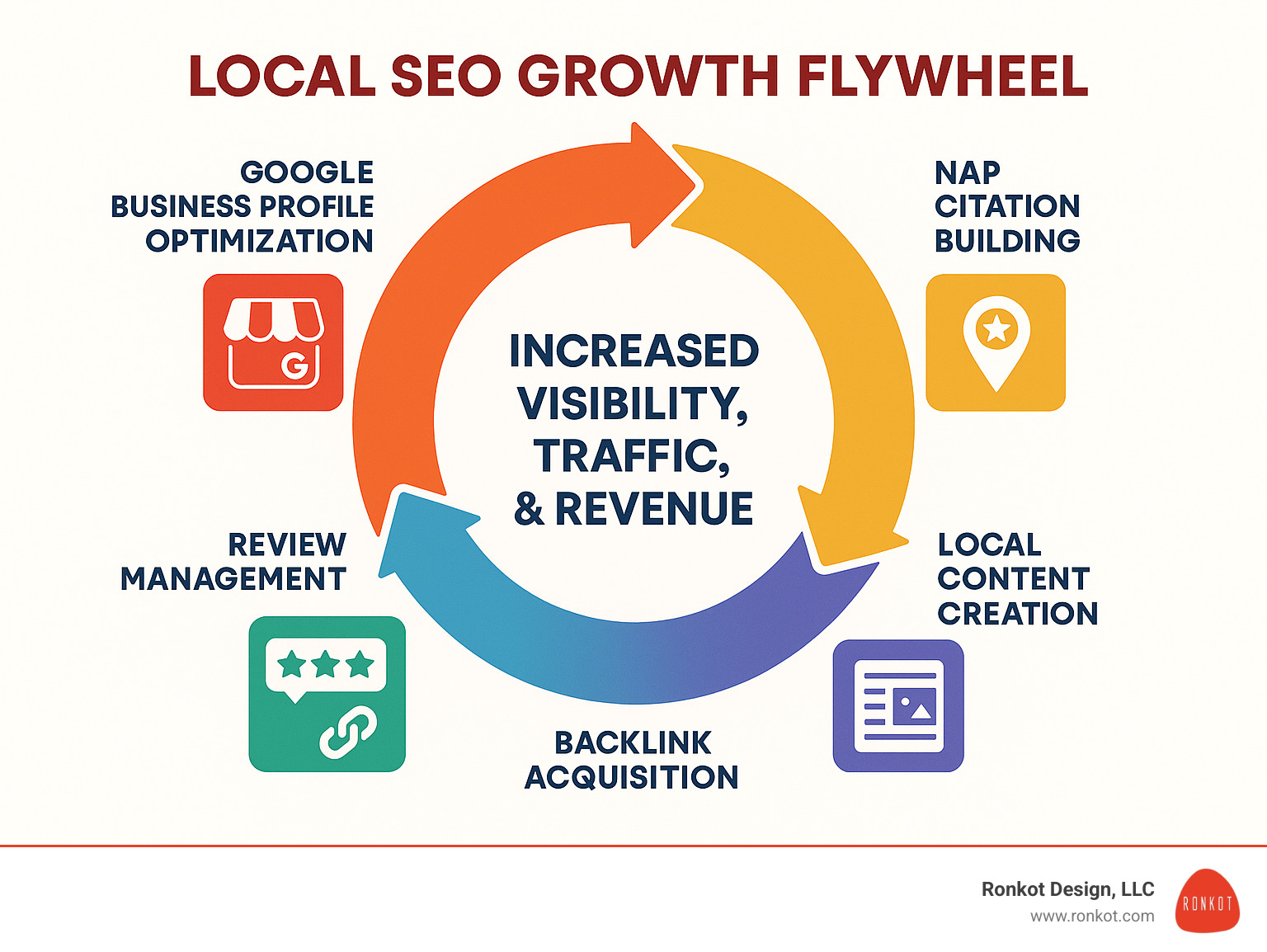
For quick reference, here are the key components of an effective local SEO strategy:
- Google Business Profile optimization – Complete all fields and keep information updated
- NAP consistency – Maintain identical Name, Address, Phone across all platforms
- Local keyword targeting – Focus on geo-specific terms your customers use
- Review management – Actively solicit and respond to customer reviews
- Mobile optimization – Ensure your site loads quickly on mobile devices
- Local content creation – Develop content relevant to your community
- Local link building – Earn backlinks from other local businesses and directories
Local SEO matters because nearly half (46%) of all Google searches have local intent, and 78% of local mobile searches result in an offline purchase within 24 hours. For small businesses with limited marketing budgets, local SEO offers an impressive 15% close rate on leads—significantly higher than many other marketing channels.
The beauty of local SEO is that it connects your business with people actively looking for your products or services in your area. Unlike traditional advertising that interrupts potential customers, local SEO helps you appear exactly when someone needs what you offer.
“Finding local customers can be difficult for small businesses, especially in today’s competitive market. But with the right local SEO strategy, your potential customers can find you—88% visit or call within 24 hours of a local search.”
I’m Ronak Kothari, CEO of Ronkot Design, and I’ve helped hundreds of small businesses implement effective local SEO for small business growth strategies that drive meaningful traffic and conversions. My decade of experience in marketing has shown that local visibility is no longer optional—it’s essential for sustainable business growth in today’s digital landscape.
Quick local seo for small business growth terms:
– google maps optimization
– local business review sites
– optimize for voice search
Local SEO for Small Business Growth: Definition, Benefits & Latest Stats
Local SEO for small business growth is the specialized art of optimizing your online presence to connect with customers right in your neighborhood. Think of it as putting up the perfect storefront sign—but in the digital world, where people are actively searching for what you offer.
When we talk about local SEO, we’re talking about a powerful $80 billion global industry that’s changing how small businesses compete. Every day, Google processes a staggering 8.5 billion searches, and nearly half of those—46% to be exact—have local intent. People aren’t just searching; they’re searching for businesses near them.
What makes this opportunity so exciting for small business owners is the conversion potential. A remarkable 80% of local mobile searches convert to some kind of action, and local SEO leads enjoy a nearly 15% close rate—numbers that would make any business owner smile.
“Before we focused on local SEO, it felt like we were the best-kept secret in Dallas,” shared one of our restaurant clients. “Now, we’re the first place people see when they’re hungry. Our weekend reservations are booked solid, and our weekday foot traffic is up 35%. It’s like we finally turned on the lights so people could find us.”
But local SEO for small business growth isn’t just about more customers—it’s about better customers. People trust local businesses they find through search, so much so that they’re willing to pay 22% more for products and services from businesses with strong online reputations. That’s real community trust you can take to the bank.
How Local SEO Differs from Traditional SEO
While traditional and local SEO share DNA, they operate on different principles:
Proximity is everything in local search. Unlike traditional SEO, where a website in California can rank for users in New York, local SEO considers where the searcher is physically located. Your smartphone’s GPS, your IP address, or the location you’ve specified all help Google determine which businesses to show you.
The Map Pack is prime real estate that only exists in local search. This coveted trio of business listings sits above traditional organic results, complete with star ratings, business hours, and directions—making it the most valuable spot on the search results page.
Different ranking factors take priority in local search. While traditional SEO focuses heavily on website authority and content, local SEO puts more weight on your Google Business Profile, consistent NAP (Name, Address, Phone) citations across the web, customer reviews, and location signals.
Geo-specific signals matter more for local businesses. Using location-based keywords like “veterinarian in Austin” and ensuring your service area information is accurate becomes crucial for connecting with nearby customers.
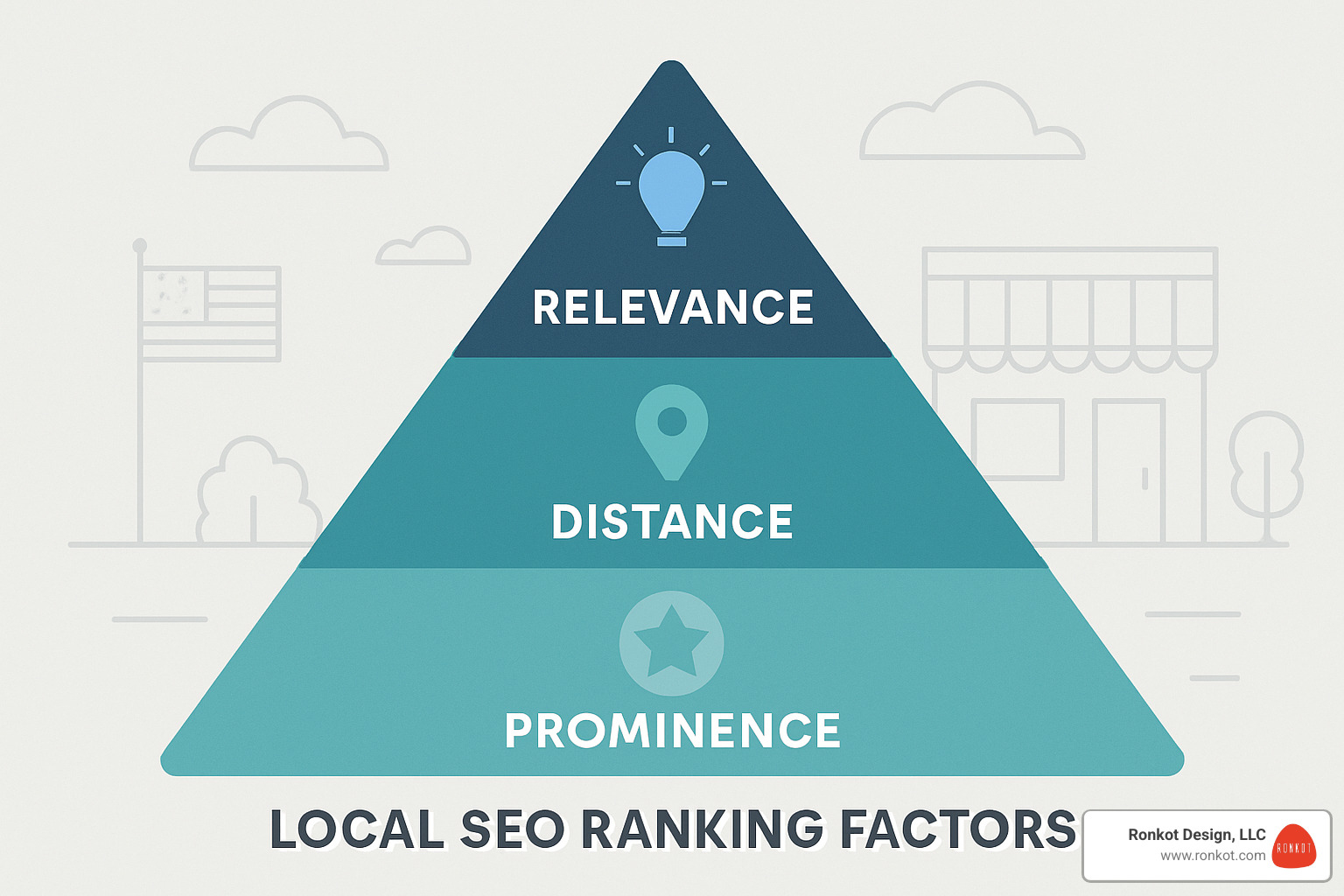
As Google’s John Mueller has explained, local results primarily consider three factors: relevance, distance, and prominence. This three-pillar approach makes local SEO a different game with different rules than traditional SEO.
Why Small Businesses Can’t Ignore Local Search
For small businesses, local search isn’t optional—it’s essential for survival in today’s digital-first world:
When 97% of consumers learn about local companies online before anywhere else, your digital presence becomes your first impression. And these aren’t just casual browsers—78% of local mobile searches result in an offline purchase, often within 24 hours.
The connection between online search and offline purchases is undeniable. When someone pulls out their phone to find a local business, 76% will visit a business they find within a day, and 28% of those searches end with a purchase.
“I was skeptical about investing in local SEO for my jewelry store,” confessed another Dallas client. “We’d been in business for 15 years and relied on word-of-mouth. But now we’re the first jeweler people see when they search in our area, and our custom design consultations have increased by 40%. The customers coming through our door already trust us because of what they’ve seen online.”
What makes local SEO for small business growth particularly powerful is how it levels the playing field. You don’t need the marketing budget of a national chain to dominate local search in your neighborhood. A targeted, well-executed local SEO strategy lets you connect with exactly the right customers at exactly the right time—when they’re actively looking for what you offer.

Ranking Factors & Algorithm Secrets
Ever wonder how Google decides which local businesses to show first? Understanding the secret sauce behind local SEO for small business growth can give you a serious competitive edge. Google evaluates local businesses using three primary factors that work together to determine who gets that coveted visibility.
According to BrightLocal’s comprehensive research, here’s what really moves the needle in local search:
- Google Business Profile signals (36%) – Having a complete, accurate, and engaging profile
- Reviews (17%) – Both quantity and quality matter, especially recent ones
- On-page SEO (34%) – Your website’s local content and technical optimization
- Backlinks (31%) – Quality links from relevant websites
- Citations (7%) – Consistent business information across the web
- Behavioral signals – How users interact with your listing
“The weight of these factors differs between the Local Pack and organic results,” notes our SEO specialist at Ronkot Design. “For the Map Pack, Google Business Profile and proximity have outsized importance, while organic rankings place more emphasis on traditional website SEO factors.”
Relevance: Matching Searcher Needs
Relevance is all about how well your business matches what someone is searching for. Think of it as Google playing matchmaker between searchers and your business.
To boost your relevance, start with precise business categories in your Google Business Profile. Don’t just select “restaurant” if you’re specifically a “Thai restaurant” or “vegan café.” Choose the primary category that best represents your core business, then add secondary categories that cover additional services.
Include relevant keywords naturally throughout your business description, services, and posts. The key word here is “naturally” – stuffing keywords will hurt more than help. One client of ours, a Colleyville TX bakery, saw a 28% increase in “bakery near me” visibility after we refined their categories from the generic “bakery” to more specific ones like “custom cake shop” and “wedding cake bakery.”
Implementing LocalBusiness schema markup on your website also helps search engines understand exactly what your business offers and where it’s located – it’s like giving Google a detailed ID card for your business.
Distance: The Power of Proximity
In local search, location really is everything. Distance refers to how far your business is from the searcher or from the location specified in their search query.
While you can’t pick up and move your physical location, you can make sure your address is perfectly accurate on both your website and Google Business Profile. If you’re a service business that travels to customers, define proper service areas rather than trying to rank everywhere.
Mobile searches have dramatically increased the importance of proximity. When someone searches on their phone for “coffee shop” without specifying a location, Google automatically factors in their current position. This makes proximity perhaps the most powerful ranking factor for mobile users.
“Near me” searches have increased by a whopping 136% year-over-year, so optimizing for these proximity-based queries is absolutely essential for local SEO for small business growth.
Prominence: Building Authority Online & Offline
Prominence is essentially your business’s reputation and authority. It’s Google’s way of determining if you’re a big deal in your community and industry.
Review volume and quality play a major role here – more positive reviews signal trust and quality to both potential customers and search engines. One plumbing client of ours moved from page two to the top of page one after implementing a simple review generation strategy that tripled their Google reviews in just four months.
Link equity (backlinks from reputable local websites) acts like votes of confidence from other established sites. Citations across the web, media mentions in local news, and even offline prominence all contribute to this factor.
A family-owned hardware store we work with in Texas improved their prominence by sponsoring local Little League teams and community events. These activities generated local press coverage, backlinks, and social media mentions, contributing to a 45% increase in their local search visibility over six months.
Understanding these ranking factors isn’t just academic – it’s the foundation for building a practical local SEO for small business growth strategy that actually works. By focusing your efforts on what truly matters to Google’s local algorithm, you’ll get more visibility, more foot traffic, and ultimately, more revenue.
The 7-Step Local SEO Blueprint
Now that you understand the fundamentals, let’s dive into our proven 7-step blueprint for local SEO for small business growth. This systematic approach has helped hundreds of our clients achieve sustainable growth through improved local visibility.
Conduct Local Keyword Research for Local SEO for Small Business Growth
Effective local keyword research isn’t just about finding popular search terms—it’s about finding the exact phrases your neighbors use when they need your services. Think of it as learning your community’s dialect for business needs.
When we worked with a small Dallas restaurant, we finded something interesting—while they were optimizing for “best restaurant Dallas,” their most valuable traffic came from “gluten-free brunch Dallas,” a term with lower competition but highly motivated searchers. Within three months of creating a dedicated page for their gluten-free options, their weekend brunch reservations jumped 22%.
Start by typing your main service plus your location into Google and see what automatically pops up. These suggestions are gold—they’re what people actually search for. Pay special attention to “near me” phrases, as these indicate someone ready to visit a business immediately.
Voice search is changing the game too. When people ask Siri or Alexa for recommendations, they use conversational phrases like “Where can I find a good plumber in Colleyville who offers emergency service?” Capturing these longer, question-based searches can put you ahead of competitors still focused only on traditional keywords.
“The magic of local keyword research isn’t finding the terms with the highest search volume—it’s finding the terms with the highest conversion potential,” as one of our clients put it after seeing their landscaping business flourish by targeting “drought-resistant landscaping Fort Worth” instead of more generic terms.
Optimize & Verify Google Business Profile
Your Google Business Profile is like your digital storefront on Main Street—it’s often the first impression potential customers have of your business. And just like a physical storefront, it needs regular attention to shine.
First things first: claim and verify your listing. It’s surprising how many businesses skip this fundamental step! Verification usually happens through a postcard Google mails to your physical address, though some businesses qualify for phone or email verification.
Once verified, choose your primary category with care—this single choice significantly impacts which searches you appear for. A bakery specializing in wedding cakes would do better selecting “Wedding Cake Bakery” rather than the more generic “Bakery” as their primary category.
Photos make a massive difference too. Businesses with more than 100 photos get 520% more calls than the average business. One boutique clothing store in Colleyville saw direction requests jump 42% after adding high-quality photos of their storefront, interior, and seasonal inventory.
Don’t let your profile gather dust! Weekly posts about special offers, events, or new products keep your profile fresh and engaging. Think of these posts as mini-advertisements that appear right in Google’s search results.
Build & Sync Accurate NAP Citations
NAP consistency sounds boring until you realize it could be the reason customers can’t find you. NAP (Name, Address, Phone number) citations are like your business’s digital fingerprint—they need to be identical everywhere they appear.
I remember working with a law firm that couldn’t understand why their local rankings were stagnant despite all their other optimization efforts. When we ran a citation audit, we finded 17 different variations of their business name across the web—some listings had “Law Offices of,” others used “Law Group,” and still others abbreviated “Associates” as “Assoc.” After cleaning up these inconsistencies, their local visibility improved by 23% in just two months.
Start by creating a master document with your canonical business information. This becomes your single source of truth. Then audit your existing citations to find inconsistencies. Tools like WhiteSpark can help with this process, showing you exactly where your business is listed and how the information appears.
The major data aggregators—Data Axle, Acxiom, and Localeze—are particularly important because they feed information to hundreds of smaller directories. Getting your information correct with these big players creates a ripple effect across the web.
“Even small differences like ‘Suite’ versus ‘#’ in your address format can confuse Google’s algorithms,” explains our citation specialist. “Think of it as giving consistent directions to your business—if every person gives slightly different directions, newcomers will get lost.”
More info about Local SEO Audit
Craft Location-Focused On-Site SEO for Local SEO for Small Business Growth
Your website needs to speak the language of local search, clearly signaling to both visitors and search engines that you serve specific communities.
When we worked with a multi-location dental practice, we created individual pages for each office that went beyond just listing the address and hours. Each page included information about parking options, nearby landmarks, community involvement initiatives, and even neighborhood-specific dental concerns. This approach increased their organic traffic by 64% year-over-year because it genuinely served the informational needs of local patients.
Make sure your location signals are clear by embedding Google Maps on your contact page. This not only helps visitors but also reinforces your location to search engines. Your business name, address, and phone number should appear consistently in your website footer and contact page, matching exactly what’s on your Google Business Profile.
Behind the scenes, implementing LocalBusiness schema markup tells search engines exactly what type of business you are, where you’re located, what services you offer, and when you’re open. Think of schema as a way to directly communicate with search engines in their preferred language.
For businesses serving multiple areas, creating location-specific pages for each community you serve makes a world of difference. A plumbing company we worked with created individual pages for each suburb they served, with unique content addressing common plumbing issues in those specific areas. Their organic traffic increased by 112% in six months.
Earn & Manage Reviews for Trust Signals
Reviews aren’t just nice to have—they’re essential. In fact, 90% of brands report that online reviews directly impact their local rankings. But beyond rankings, reviews build trust, and trust drives business.
The secret to getting more reviews isn’t complicated: just ask! Create a direct link to your Google review page and share it with customers after positive interactions. One restaurant client added a simple QR code to their receipts with the message “Loved your meal? We’d love your review!” This tripled their monthly review volume.
How you respond to reviews matters just as much as getting them. Respond to positive reviews with genuine appreciation, mentioning something specific about their visit when possible. For negative reviews, respond promptly, professionally, and with a solution-oriented approach. Then take the conversation offline to resolve the issue.
“The way you handle criticism online shows potential customers more about your business values than a dozen 5-star reviews ever could,” as one of our home service clients finded after turning a disappointed customer into a loyal advocate through thoughtful problem resolution.
Review platforms have strict policies about incentivizing reviews. Never offer discounts or rewards specifically for Google reviews, as this violates their terms of service and can result in penalties.
Secure Local Backlinks & Partnerships
Backlinks are like votes of confidence from other websites, telling Google your business is trustworthy and relevant. For local businesses, quality trumps quantity every time.
Community involvement naturally generates valuable backlinks. A home services company we work with sponsors a little league team and volunteers for Habitat for Humanity projects. These activities not only create goodwill but also earn links from community organization websites and local news coverage.
Look for complementary, non-competing businesses to partner with. A wedding photographer client of ours created a “Dallas Wedding Vendor Guide” featuring florists, venues, caterers, and DJs they’d worked with. Each featured business linked back to the guide from their own site, creating a network of relevant local backlinks while also generating referral business.
Your local Chamber of Commerce, Better Business Bureau, and industry associations typically offer member directories with backlinks. While these links are available to competitors too, not having them puts you at a disadvantage.
Local news outlets are always looking for expert commentary and interesting stories. One HVAC client established himself as the go-to expert for local TV stations during extreme weather events, earning valuable media mentions and links while positioning his company as an authority.
More info about avoiding link mistakes
Ensure Mobile UX & Technical Health
With 58% of people searching for local businesses on their smartphones daily, your website needs to shine on mobile devices. Think about it—someone searching for “emergency plumber near me” is probably dealing with a flooded bathroom, not sitting comfortably at a desktop computer.
Page speed is particularly critical for local searches. When we improved a Colleyville retail client’s mobile load time from 6.2 seconds to 2.4 seconds, their bounce rate dropped by 31%. Every second counts when someone is looking for your business on the go.
Responsive design ensures your site looks good and functions well on any device. Test your site on various screen sizes to ensure buttons are large enough to tap easily, text is readable without zooming, and navigation is intuitive on smaller screens.
Google’s Core Web Vitals have become increasingly important ranking factors. These metrics measure loading performance, interactivity, and visual stability. Improving these technical aspects not only helps your rankings but also creates a better user experience for potential customers.

“Technical SEO might seem less exciting than other marketing activities, but it’s like maintaining your car’s engine—neglect it, and eventually you’ll be stranded on the side of the road watching competitors drive by,” says our technical SEO specialist.
A final technical consideration is ensuring your site is secure with HTTPS. Beyond the ranking benefit, this builds trust with visitors who are increasingly security-conscious, especially when submitting contact information or making purchases.
Measure Success & Avoid Pitfalls
Putting local SEO for small business growth strategies into action is just the beginning of your journey—knowing if they’re actually working is equally important. Without proper measurement, you’re essentially navigating without a compass.
Here’s a statistic that never fails to impress our clients: 78% of local mobile searches result in an offline purchase. That’s right—when someone searches for a local business on their phone, more than three-quarters of the time they end up buying something. This powerful connection between searching and spending is why tracking your local SEO performance matters so much.
Must-Track Metrics & Tools
When I sit down with small business owners to review their local SEO progress, I always focus on metrics that actually matter to their bottom line:
Your local pack visibility shows whether you’re appearing in that coveted Google Map Pack when people search for your services. This prime real estate often gets the majority of clicks, so tracking your position here is crucial.
Organic visibility in traditional search results still matters too, especially for geo-modified searches like “dentist in Dallas TX.” Many of our clients see significant traffic from these positions.
Your Google Business Profile insights tell a rich story about how people interact with your business online. I always get excited when I see increases in direction requests—that’s a clear signal that searchers are planning to visit your location.
Search impressions and clicks from Google Search Console help you understand broader trends in your visibility. One restaurant client noticed a sudden spike in impressions for “outdoor dining” terms during the pandemic, which prompted them to feature their patio more prominently in their marketing.
Conversion actions like phone calls, form submissions, and direction requests connect your SEO efforts to actual customer acquisition. When a Dallas florist we work with implemented call tracking, they finded that 43% of their phone orders came directly from local search.
Revenue attribution is the holy grail. Whenever possible, ask new customers how they found you to connect your SEO efforts to actual sales.
Tools like Local Falcon or Grid My Business have been game-changers for our clients. These specialized platforms show how your Map Pack rankings vary across different locations in your service area. It’s fascinating to see the “ranking bubble” around a business location—sometimes you’ll rank #1 just a mile away but disappear completely five miles out.
“Don’t just track rankings—track the right rankings,” I often tell clients. “A #1 ranking for a term no one searches for is worthless compared to a #3 ranking for a high-volume, high-intent keyword.”
A Texas law firm we worked with made an interesting findy through grid-based tracking. They ranked beautifully within a 5-mile radius of their office but practically disappeared in wealthy neighborhoods just 2 miles further out. By creating neighborhood-specific content and building relationships with community organizations in those areas, they expanded their effective ranking radius and attracted several high-value clients.
Top Local SEO Mistakes and How to Dodge Them
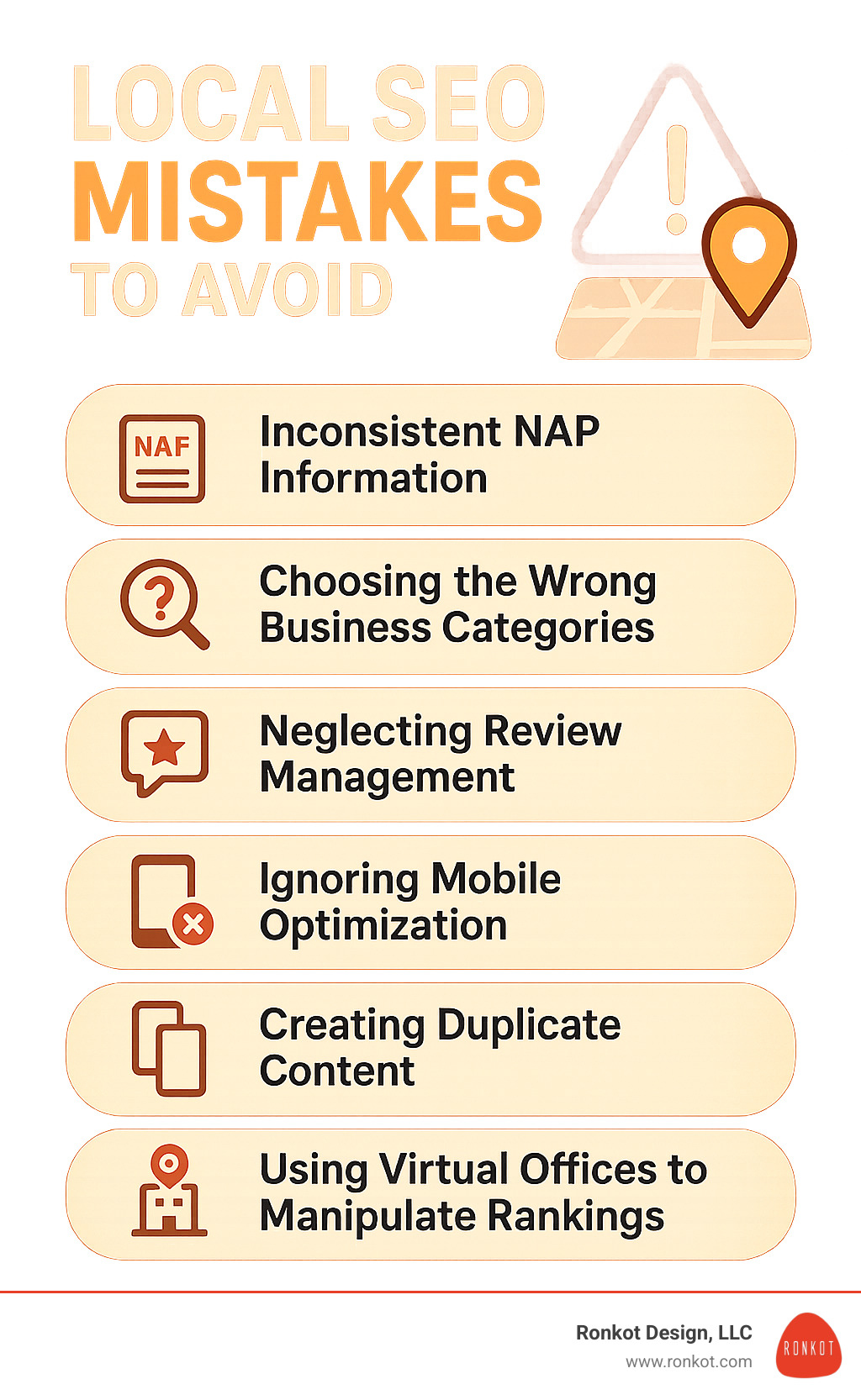
Even the savviest business owners make these common local SEO mistakes. Let me share how you can avoid them:
Inconsistent NAP information across different platforms confuses both Google and potential customers. One of our clients, a plumbing company, had three different phone numbers and two slightly different business names across various directories. No wonder their rankings were suffering! A thorough audit and cleanup made a world of difference.
Choosing the wrong business categories can seriously limit your visibility. A boutique fitness studio we worked with was categorized simply as “Gym” when “Pilates Studio” and “Yoga Studio” would have matched their services much better. After updating their categories, their visibility for those specific searches increased dramatically.
Neglecting review management is like ignoring customers who walk through your door. Reviews aren’t just about stars—they’re conversations with potential customers. A Texas bakery owner I work with responds to every review personally, even the occasional negative ones, and has built incredible community goodwill as a result.
Ignoring mobile optimization is particularly harmful for local businesses. I always remind clients that people searching “near me” are often already out and about, looking at their phones. If your site loads slowly or displays poorly on mobile, you’re losing customers who are ready to visit.
Creating duplicate content for multiple locations is a common mistake that can backfire quickly. A multi-location client once created nearly identical pages for each location, simply changing the city name. Their rankings plummeted due to duplicate content issues. We helped them develop unique content for each location, highlighting local team members, community involvement, and location-specific services, which restored and improved their rankings.
Using virtual offices to manipulate rankings might seem clever, but it violates Google’s guidelines and can result in serious penalties. I’ve seen businesses get completely removed from Google’s local results after this tactic was finded.
Failing to track phone calls from search means missing a crucial piece of the conversion puzzle. Many small businesses receive more phone calls than website form submissions, especially in service industries.
The good news is that most of these mistakes are relatively easy to fix once you’re aware of them. With proper tracking and a clear understanding of what works (and what doesn’t) in local SEO, your small business can gain a significant advantage over competitors who are still making these common errors.
Frequently Asked Questions about Local SEO for Small Business Growth
What timeline should I expect before seeing results?
When it comes to local SEO, patience truly is a virtue. Most of our clients start seeing meaningful results within 3-4 months, but this timeline can flex depending on your specific situation.
Think of local SEO like planting a garden – you don’t get tomatoes the day after you put seeds in the ground! Several factors influence how quickly your business will bloom in local search:
Competition in your market plays a huge role. If you’re a coffee shop in a small town with few competitors, you’ll likely see results faster than if you’re a Dallas attorney competing against hundreds of established firms.
Your starting point matters tremendously. A brand-new business starting from scratch typically takes longer to gain traction than an established business that already has some online presence.
Citation indexing works on Google’s timeline, not yours. It can take several weeks for new or updated business listings to be fully processed and start influencing your rankings.
Review velocity should follow a natural pattern. A sudden flood of 50 new reviews looks suspicious to Google (and potential customers!). A steady stream of authentic reviews builds credibility over time.
“We generally see initial improvements in Map Pack visibility within 4-6 weeks of implementing our recommendations,” shares our SEO team lead. “However, sustainable growth in traffic and conversions typically takes 3-6 months of consistent effort.”
I love sharing the story of our Colleyville TX client, a family dental practice that was nearly invisible online when they came to us. They saw their first ranking improvements around the 5-week mark, but the real magic happened over the following 8 months as all aspects of their strategy matured – they now dominate local searches and have welcomed over 200 new patients from their improved visibility.
Do I need a physical address to rank?
This is one of the most common questions we hear from service-based businesses, and I have good news: you absolutely can achieve strong local rankings without a storefront!
Service-area businesses (SABs) like plumbers, landscapers, and mobile pet groomers can perform extremely well in local search, even without displaying a physical address. Here’s what you need to know:
You must have a legitimate physical location to qualify for a Google Business Profile – but this can be your home office if that’s where you operate from. Google just needs to verify you’re a real business with a real location.
If you don’t serve customers at your location, you can (and should) hide your address in your Google Business Profile settings. This protects your privacy while still allowing you to appear in local results.
Be sure to define your service areas accurately in your Google Business Profile. You can add multiple cities, neighborhoods, or zip codes where you provide services.
Creating location-specific content focused on the areas you serve can help compensate for businesses that have the proximity advantage of physical locations in those areas.
“Service-area businesses face unique challenges but can absolutely compete in local search,” explains our local SEO specialist. “We’ve helped numerous service providers rank well by leveraging their mobility as an advantage in their content and marketing.”
One of our most successful clients is a mobile dog groomer who serves 12 communities around Dallas. By creating neighborhood-specific pages that highlight local dog parks and pet-friendly establishments, she’s managed to rank in the top 3 results for “dog groomer near me” searches across her entire service area – all without a commercial storefront!
How much should a small business budget for local SEO?
When it comes to budgeting for local SEO for small business growth, there’s no one-size-fits-all answer, but I can give you some realistic frameworks based on our experience with hundreds of small businesses.
If you’re taking the DIY approach, expect to invest $100-300 monthly for essential tools and directory listings. This route requires significant time investment from you or your team, but can work well for very small businesses in less competitive markets.
Many businesses find success with partial outsourcing, spending $500-1,500 monthly to get specialized help with the most technical or time-consuming aspects while handling some tasks in-house. This hybrid approach often delivers the best value for growing businesses.
For a full-service agency handling every aspect of your local SEO, typical investments range from $1,000-5,000 monthly depending on your market, competition, and growth goals. While this requires a larger financial commitment, it frees you to focus entirely on running your business.
The good news? Local SEO typically delivers exceptional return on investment. In fact, 40% of local SEO campaigns achieve a 500% or better ROI, making it one of the most cost-effective marketing channels available to small businesses.
“The question isn’t whether you can afford local SEO—it’s whether you can afford to ignore it,” notes our marketing director. “When 62% of consumers will disregard a business if they can’t find them online, visibility isn’t optional.”
I always recommend starting with a professional audit to identify your highest-impact opportunities. This targeted approach ensures you’re addressing the most critical issues first, delivering the best early returns on your investment and creating sustainable local SEO for small business growth.
Conclusion
Local SEO for small business growth isn’t just another marketing tactic—it’s the bridge connecting your business to customers already searching for what you offer in your neighborhood. The strategies we’ve explored throughout this guide represent proven pathways to sustainable growth for small businesses in Texas and beyond.
The numbers tell a compelling story: nearly half of all Google searches have local intent, 78% of local mobile searches lead to in-store purchases, and local SEO leads convert at an impressive 15% rate. For small businesses with limited marketing resources, these statistics represent an opportunity that simply can’t be overlooked.
At Ronkot Design, we’ve seen how a thoughtful, data-driven approach to local SEO transforms businesses. One of our clients, a family-owned bakery in Colleyville, went from being virtually invisible online to becoming the go-to destination for custom cakes in their area—all because they committed to implementing these local search strategies consistently.
“Local SEO gave us a voice in our community we never had before,” they shared. “We’re now connecting with customers who live just blocks away but never knew we existed.”
Local SEO is more marathon than sprint. Search algorithms evolve, competitor strategies shift, and consumer habits change. The businesses that thrive are those that view local visibility as an ongoing commitment rather than a one-time project.
As you implement your own local search strategy, keep these core principles close:
Focus on genuine value in everything you create and share online. Google rewards businesses that truly serve their communities.
Maintain perfect data consistency across all your digital touchpoints. Those small details matter enormously.
Engage authentically with your community both online and in the physical world. The lines between digital and local presence continue to blur.
Track metrics that matter to your specific business goals. Rankings are just the beginning—conversions and revenue are the true measure of success.
Stay curious and adaptable as local search continues to evolve. The businesses that remain informed typically stay ahead.
By following this growth guide, you’re positioning your business to become not just visible but truly prominent in both search results and your local community. The journey may require patience and persistence, but the rewards—increased foot traffic, phone calls, website visits, and ultimately revenue—make it well worth the effort.
We’d love to hear about your local SEO journey. What strategies have worked best for your business? What challenges are you facing? Connect with us and let’s continue the conversation.
More info about building your Local SEO Strategy
Ronak Kothari is the founder of RONKOT, a full-service digital marketing agency.