


Ronak Kothari is the founder of RONKOT, a full-service digital marketing agency.
Digital Print and Advertising: Maximize 2025
Why Digital Print and Advertising Matters for Your Business
Digital print and advertising are two complementary approaches to reaching your customers. Here’s what you need to know:
Digital Print Advertising:
- Uses digital files to create physical materials like brochures, flyers, and direct mail.
- Offers fast turnarounds and personalization through Variable Data Printing.
- Builds trust, as 80% of consumers act on direct mail vs. 45% on electronic ads.
- Creates lasting impressions with tangible, sensory engagement.
Digital Advertising:
- Delivers ads through online channels like search engines, social media, and display networks.
- Provides real-time tracking and precise audience targeting.
- Enables quick adjustments and global reach at lower entry costs.
- Works best for immediate interaction and measurable conversions.
The Key Insight: The most successful businesses don’t choose one over the other—they use both strategically. Print materials stay in homes and offices longer, increasing brand visibility, while digital ads provide trackable metrics and immediate engagement. When combined, they can boost response rates by 20%.
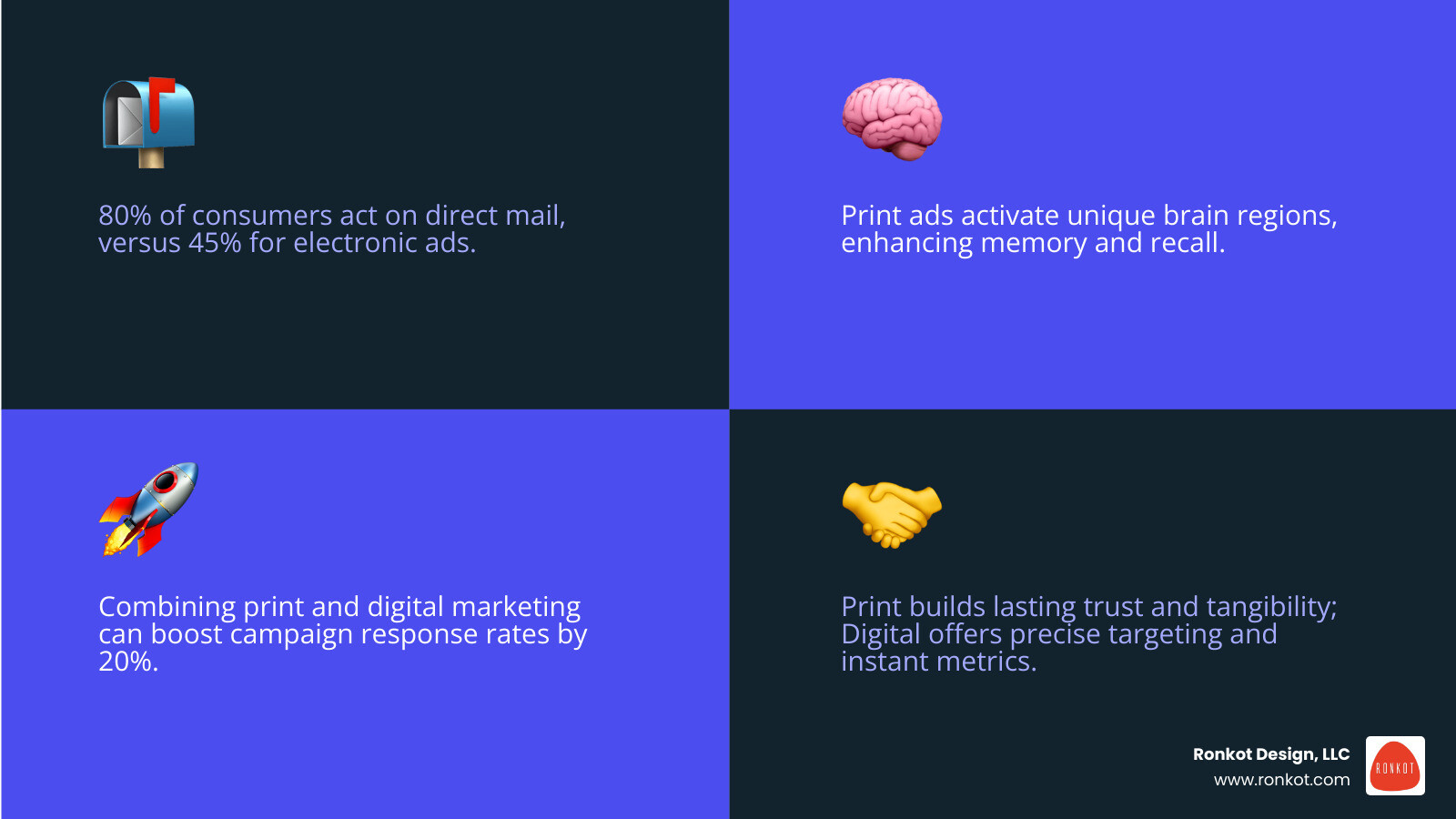
Key Statistics: Nearly 80% of consumers act on printed mail advertisements compared to 45% who act on electronic ads. Print ads activate different parts of the brain, leading to higher recall and memory retention.
I’m Ronak Kothari, CEO of Ronkot Design, LLC. With over a decade of experience at the intersection of digital print and advertising, I’ve seen how integrating both mediums creates powerful marketing results that neither can achieve alone. In this guide, we’ll break down how each medium works and how to create an integrated strategy that maximizes your marketing investment.
The Two Sides of the Advertising Coin: Defining the Mediums
When we talk about digital print and advertising, we’re exploring two powerful ways to reach your audience: one physical, one virtual. Understanding how they work—separately and together—is the foundation of smart marketing. Let’s break down what each one means for your business.
What is Digital Print Advertising?
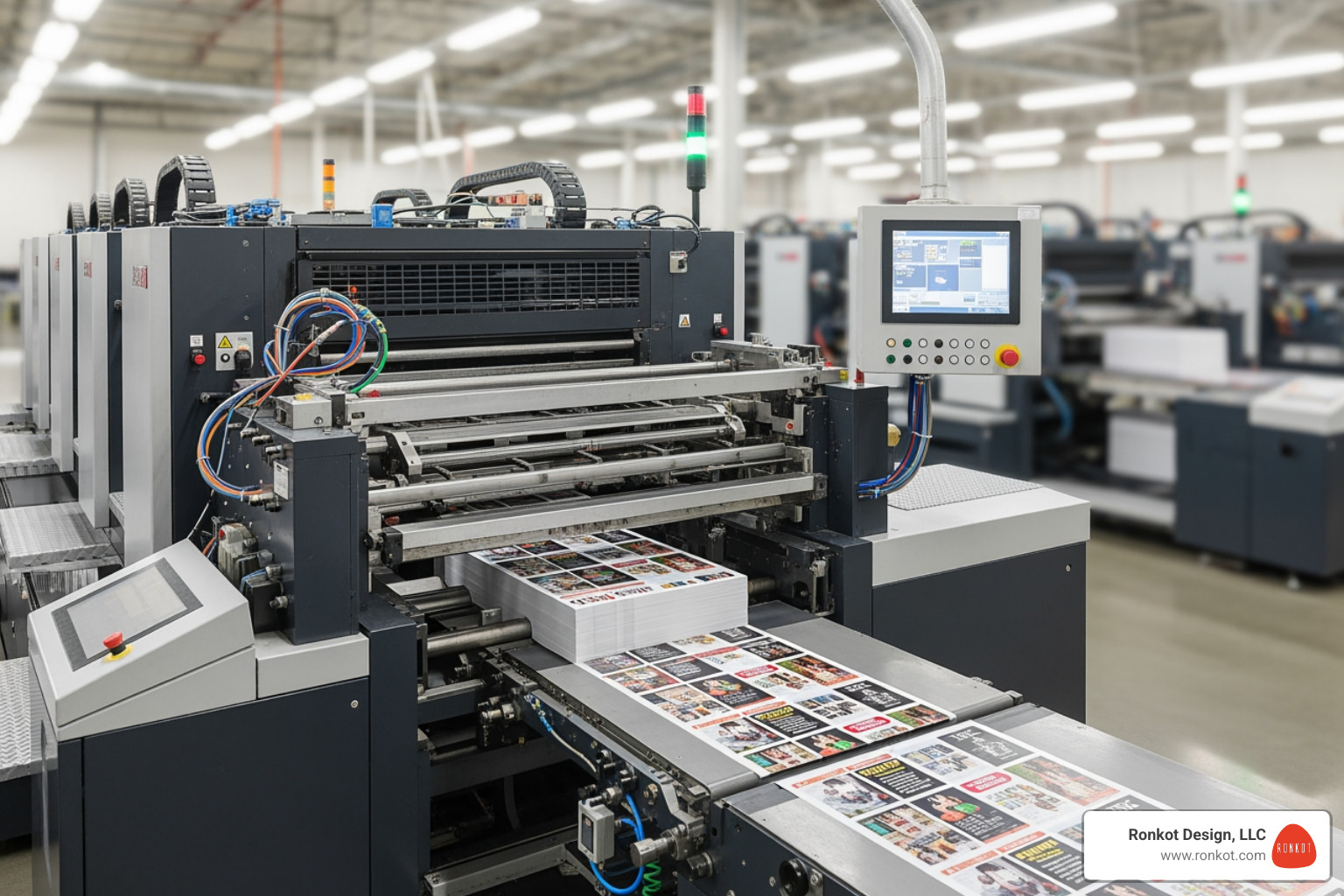
Digital print advertising creates physical marketing materials—brochures, flyers, direct mail—using modern digital technology. Instead of creating expensive metal plates for every print job, digital printing sends files straight from a computer to the printer. This technology means faster turnaround times and incredible flexibility.
Need 100 flyers printed in Dallas, TX by Friday? Digital print makes it happen. Want to update a design mid-campaign? No problem—no plates to remake or massive setup costs.
The real magic is Variable Data Printing (VDP), which lets you personalize every single piece in a print run. Instead of one generic postcard, you can send 1,000 unique postcards, each with a different name, custom offer, or message based on purchase history. One customer might see an ad for athletic socks, while another sees a promotion for scarves.
Digital print is ideal for small to medium batches where you need speed and personalization. It uses toner or inkjet technology, meaning no minimum order quantities and no weeks of setup time. You get the agility of digital marketing with the tangible impact of print.
What is Digital Advertising?
Digital advertising lives entirely online. It’s every ad you see while browsing websites, scrolling social media, checking email, or searching on Google. These ads reach people wherever they spend their digital time.
Key channels include Search Engine Marketing (SEM), which puts your business at the top of search results, and social media ads on platforms like Facebook and Instagram. Display ads are the visual banners you see on websites. Email marketing delivers messages to subscribers’ inboxes, while pay-per-click (PPC) campaigns ensure you only pay when someone clicks your ad.
What makes digital advertising so appealing is the data. You can see how many people viewed your ad, clicked it, and made a purchase in real time. This allows you to adjust your strategy on the fly. The targeting precision is also remarkable; you can reach specific demographics, like 35-year-old homeowners in Dallas who love gardening.
With its global reach and lower entry cost, digital advertising offers best flexibility and measurability for businesses looking to scale quickly. The smartest marketers understand how digital print and advertising work together, creating campaigns where each medium amplifies the other’s impact.
Print vs. Digital: A Head-to-Head Comparison
Asking “which is better?” is the wrong question. The real question is: “which strengths does each medium bring to my specific business goals?” Let’s break down how digital print and advertising compare across the metrics that matter most.
Engagement and Trust: The Power of Touch
There’s something powerful about holding a piece of marketing material. It’s not just nostalgia—it’s neuroscience. Print advertising creates a tangible, sensory experience that digital can’t replicate. When someone holds your brochure, they engage multiple senses, contributing to a deeper, more memorable brand experience.
Neuroscience research on print’s impact on the brain shows that print ads activate different neural pathways than digital ads, leading to better memory encoding and significantly improved ad recall. People remember your message longer when they’ve physically touched it.
Here’s a key statistic: nearly 80% of consumers act on directly printed mail advertisements, compared to just 45% who act on electronic ads. That’s a massive gap in response rates.
There’s also the credibility factor. In an era of “digital ad fatigue,” many consumers tune out or distrust online ads. Print materials carry an inherent sense of legitimacy. A well-designed piece from our Custom Business Printing Services in Dallas, TX signals that your business has invested in quality.
Physical materials also have staying power. A postcard on a refrigerator or a brochure on a coffee table increases your brand visibility long after a digital ad has disappeared.
Reach, Targeting, and Measurement: The Data Advantage
If print wins on trust and tactile engagement, digital dominates in reach, targeting precision, and real-time measurement. Digital advertising allows you to laser-focus on specific audiences with remarkable accuracy. The demographic and geo-targeting capabilities are best, letting you serve different messages to different segments simultaneously.
The measurability is equally impressive. With digital, we can track impressions, clicks, and conversions in real-time, allowing for A/B testing and on-the-fly campaign adjustments.
Here’s how the two mediums compare across key metrics:
| Feature | Digital Print Advertising | Digital Advertising |
|---|---|---|
| Cost per Unit | Higher for small runs, cost-effective for targeted campaigns | Lower entry cost, highly scalable |
| Targeting Precision | Excellent with VDP and direct mail lists | Exceptional with behavioral and demographic data |
| Measurability (ROI) | Trackable via QR codes, custom URLs, unique codes | Highly detailed with real-time analytics |
| Reach Potential | Local to regional, limited by physical distribution | Global, virtually unlimited online audience |
| Lead Time | Faster than traditional offset, includes production time | Near-instant deployment and updates |
Digital print has also evolved its targeting and measurement. Through Variable Data Printing (VDP), our Dallas Variable Data Printing services create highly personalized direct mail. By integrating QR codes, custom URLs, or promo codes into print materials, we can track exactly how recipients respond, bridging the gap between print’s tangible impact and digital’s data insights.
The bottom line: print builds trust and creates memorable experiences, while digital provides reach and actionable data. The smartest strategy uses both together.
The Strategic Power of Digital Print and Advertising
The real magic happens not when you choose between print and digital, but when you strategically combine them. An integrated, omnichannel approach reaches audiences across multiple touchpoints in ways that single-channel marketing simply can’t match.
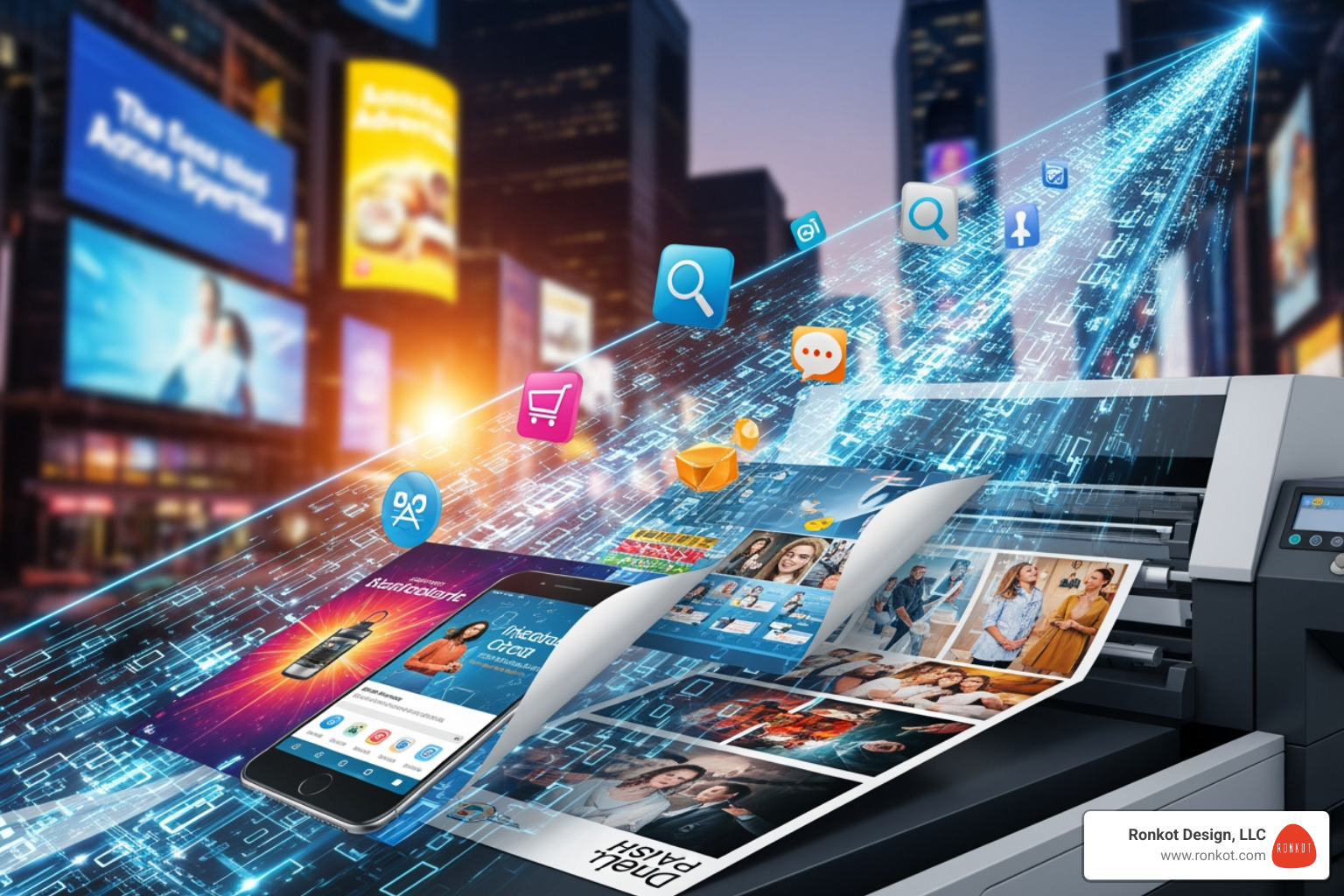
Print builds trust and makes a lasting impression, while digital provides reach and measurable engagement. When these two work together, they create something more powerful than the sum of their parts. This section explains how to create a unified strategy that leverages the strengths of both mediums.
Creating an Integrated Omnichannel Campaign
Companies that make digital print and advertising coexist have the most successful marketing campaigns. Combining both can boost your response rates by 20%. An integrated omnichannel campaign seamlessly blends the physical and digital worlds, creating a cohesive customer journey.
Imagine a brochure with a QR code. When scanned, it directs the user to a landing page or promotional video. You’ve just moved your customer from a tangible interaction to a trackable online engagement. Custom URLs and tracking mechanisms work similarly, allowing you to see precisely how many people are engaging with your physical materials online.
Consistent branding across all channels is crucial. Whether someone receives a postcard from our Dallas Direct Mail Printing services or sees your social media ad, they should experience the same colors, fonts, and messaging. This consistency builds trust and recognition.
This synergy is powerful for full-funnel marketing. Print can be the initial touchpoint, building trust. Then, you can use programmatic display advertising to retarget those who engaged with your print materials online. This integrated approach leverages the high engagement of print to drive traffic and conversions online, underscoring the Print Marketing Importance for Business in a digital-first world.
Executing Your Digital Print and Advertising Campaign
An effective digital print and advertising campaign requires careful planning and execution. Our data-driven, customer-centric approach at Ronkot Design, LLC, ensures every step is custom to your business needs.
- Define Goals & Audience: We start by understanding your objectives and target audience, using tools like Google Analytics and customer research to form the campaign brief.
- Create Compelling Artwork: We design high-quality artwork formatted for both digital presses and online channels, ensuring consistency and impact.
- Integrate Tracking Mechanisms: We add QR codes, short URLs, or UTM codes to your materials to measure the effectiveness of both print and digital efforts, proving ROI.
- Choose Distribution Channels: We select the right channels, whether it’s direct mail through our Dallas Direct Mail Printing services or targeted ads on social media and search engines.
- Launch & Monitor: We continuously track key metrics, ready to adjust ad content or distribution based on real-time performance data.
- Analyze and Refine: Post-campaign, we analyze A/B tests and performance data to identify what worked, ensuring continuous improvement for future campaigns.
The Future of Advertising: Trends and Innovations
The advertising landscape never stands still. For digital print and advertising, the future isn’t about one medium replacing the other—it’s about sophisticated integration that brings out the best in both. At Ronkot Design, LLC, we monitor these trends to keep our clients ahead of the curve.
Key Benefits of Digital Print and Advertising in the Modern Era
The combined power of digital print and advertising is open uping new levels of marketing effectiveness.
Hyper-personalization is becoming the standard. By integrating AI with CRM systems, we can create direct mail pieces dynamically generated for each customer based on their real-time online behavior, driving significantly higher conversion rates.
Sustainability is essential. As consumers prioritize environmental responsibility, we are seeing wider adoption of eco-friendly inks, recycled papers, and energy-efficient digital presses. We are committed to ensuring our marketing efforts are as green as possible.
Augmented Reality (AR) in print merges the physical with the digital. AR allows customers to scan a printed ad with their phone to see a 3D product model, watch a video, or virtually try on clothes, creating an immersive brand experience.
Interactive experiences are also changing print. A print piece can now be a gateway to online quizzes, virtual events, or personalized content, creating a richer digital brand interaction.
The Evolving Digital Landscape
While print innovates, the digital world continues its rapid evolution.
The cookieless future is reshaping digital advertising. With browsers phasing out third-party cookies by 2025, the landscape is becoming more privacy-centric. This shift requires new strategies focused on first-party data, making the trusted, direct connection offered by print even more valuable.
Video and voice search are dominating content consumption. Short-form video captivates audiences, while voice search creates new opportunities for businesses to connect with customers through spoken queries. Our digital strategies adapt to these trends to meet audiences where they are.
Artificial Intelligence is revolutionizing ad optimization. AI systems can predict which ads will perform best, personalize content, and optimize budget allocation in real-time, making digital campaigns more effective than ever.
Most importantly, there’s a growing need for trustworthy touchpoints. In a world of digital noise and skepticism, the inherent credibility of print is a crucial channel for establishing trust and authenticity, which can then be amplified through digital interactions.
Frequently Asked Questions about Digital and Print Advertising
Is print advertising still effective in 2024?
Yes, print advertising remains highly effective. It thrives as a powerful complement to digital strategies. Neuromarketing studies show that print ads activate parts of the brain that lead to stronger engagement and memory formation. People simply remember what they read in print better than what they see on a screen.
The results speak for themselves: nearly 80% of consumers act on direct mail, while only 45% act on electronic ads. In an age of digital fatigue, a physical mailer cuts through the noise and builds credibility. When integrated with digital, digital print and advertising campaigns can see response rates boosted by 20%.
Which is more cost-effective, print or digital?
It depends on your goal, as both digital print and advertising offer distinct cost advantages. The most cost-effective approach usually involves a strategic blend of both.
Digital advertising typically has a lower entry cost, making it accessible for smaller budgets and easy to scale. You can also adjust spending on the fly, pausing campaigns that aren’t performing.
Digital print advertising is cost-effective for smaller, targeted runs, as you only print what you need. While personalized campaigns may have a higher per-unit cost, the increased engagement often delivers a stronger ROI. Print materials also have a longer shelf life, providing extended brand visibility.
At Ronkot Design, LLC, we find the most cost-effective strategy is a balanced one: use digital for immediate engagement and measurement, and use print for building credibility and creating memorable experiences.
How can I track the ROI of my print advertising?
Tracking print ROI is straightforward with modern techniques that bridge your physical materials to digital tracking systems.
-
QR Codes: These scannable codes are printed on materials and direct users to specific landing pages. We can track every scan and the subsequent actions taken, such as a form submission or purchase.
-
Custom Landing Page URLs: Instead of your main website, we print a unique URL (e.g., yoursite.com/offer). Traffic to this URL is directly attributed to your print campaign.
-
Dedicated Phone Numbers: By assigning a unique, trackable phone number to your print ads, every call is attributed directly to that campaign, which is ideal for service-based businesses.
-
Exclusive Coupon Codes: When customers use a specific code from your print ad to get a discount, you can easily count the conversions from that campaign.
Our Dallas Direct Mail Printing services integrate these tracking mechanisms to ensure you can measure performance and calculate ROI with confidence.
Conclusion

After years of helping businesses in Dallas, Colleyville, and across Texas, I’ve learned one crucial truth: the question isn’t whether print or digital is better. The real question is how to make them work together.
Throughout this guide, we’ve seen how digital print and advertising each bring unique strengths to the table. Print creates tangible moments that build trust, while digital provides the reach, data, and agility to optimize your message.
The businesses I see succeeding aren’t choosing sides. They use print to establish credibility and make a lasting impression, then use digital to extend the conversation and track results. When a customer scans a QR code on your printed postcard and lands on your website, that’s not print winning or digital winning—that’s smart marketing.
Response rates can jump by 20% when companies integrate both approaches thoughtfully. It’s about meeting your customers where they are—in the physical world and online—with a consistent message that reinforces your brand.
At Ronkot Design, LLC, our data-driven, customer-centric approach means we build a strategy that uses each channel for what it does best. The future of marketing is a seamless experience that leverages the trust of print and the reach of digital to drive real growth.
Ready to build a comprehensive strategy that opens up your brand’s full potential? Explore our Marketing Collateral Printing Services and let’s create something powerful together.
Ronak Kothari is the founder of RONKOT, a full-service digital marketing agency.